
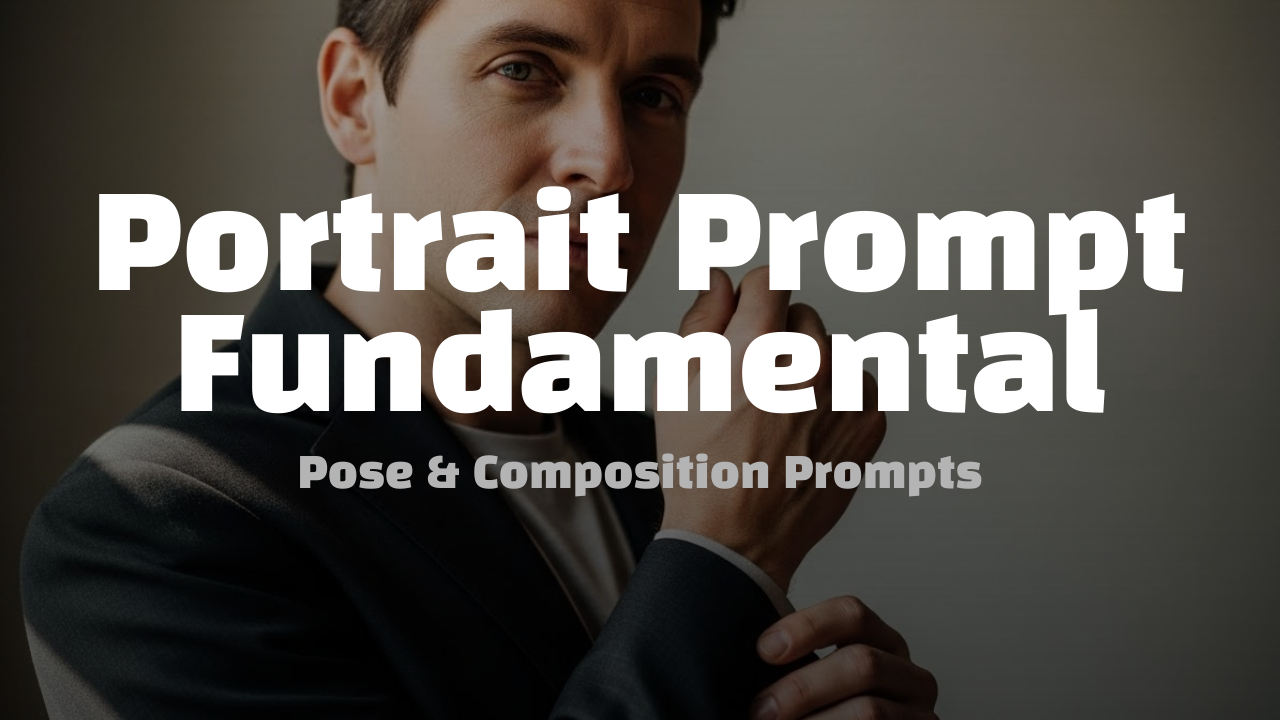
Why portraits look stiff (and how this chapter fixes it)
Even with great face and skin prompts, portraits can feel “posed” or artificial when the body language is unclear. The solution is not more adjectives—it’s specific posture + a believable hand action + clear framing + intentional gaze.
This chapter gives you:
- 20 reliable pose templates (standing/sitting/walking + angles)
- Hand actions that reduce stiffness and distortion
- Shot-size checklists (close-up, half-body, full-body)
- Group (2–5 people) balance and gaze handling
- Couple portrait staging (distance → touch → intimacy progression)
- Corrections to reduce “beauty-filter / model shoot” vibes
The master formula (copy/paste)
[subject identity],[pose + weight shift + body angle],[hand action + hand visibility],[gaze direction + expression tone],[shot size + camera angle + lens],[composition cues + negative space],[wardrobe movement + environment interaction],[lighting + background + color grade]Safe defaults (natural baseline)
Use these defaults to keep portraits candid and human:
- Pose: “relaxed posture, slight weight shift, asymmetry in shoulders/hips”
- Hands: “hands doing something simple, fingers relaxed, hands partially visible”
- Gaze: “looking slightly off-camera” (often reads more natural than constant direct eye contact)
- Camera: “eye-level or slightly above eye level” for most natural results
- Avoid: “perfect model pose,” “pageant posture,” “extreme S-curve,” “hyper-flexed fingers,” “awkward hands”
1. Pose Library (20 Natural Templates)
The goal is to specify where the weight is, what the shoulders/hips are doing, and what the hands are doing.
Standing (1–8)
1) Weight shift + soft shoulders
standing, relaxed posture, weight on back leg, front knee slightly bent, shoulders relaxed, slight torso angle2) Lean on wall + candid
standing, leaning lightly against a wall, one foot crossed over the other, shoulders soft, relaxed stance3) Hands in pockets (thumbs out)
standing, casual stance, hands in pockets with thumbs out, relaxed shoulders, slight hip shift4) Jacket adjustment
standing, adjusting jacket cuff, subtle weight shift, shoulders slightly angled, relaxed posture5) One hand holding strap/bag
standing, one hand holding bag strap, other hand relaxed at side, slight torso turn, natural posture6) Arms loosely folded (not tight)
standing, arms loosely folded, shoulders relaxed, chin slightly down, natural stance7) Over-shoulder glance
standing, torso turned slightly away, looking over shoulder, relaxed neck, subtle weight shift8) Step-forward pause
standing, one foot stepping forward mid-pause, slight motion in clothing, relaxed shouldersSitting (9–14)
9) Seated edge + slight lean
sitting on the edge of a chair, slight forward lean, elbows resting lightly on thighs, relaxed posture10) Seated twist (torso angle)
sitting, torso turned 20–30 degrees, shoulders relaxed, one hand resting on knee, natural angle11) Crossed legs + hand task
sitting, legs crossed, one hand holding a cup, other hand resting naturally, relaxed posture12) One knee up (casual)
sitting, one knee up, forearm resting casually on raised knee, relaxed shoulders13) Couch sit + look away
sitting on a couch, leaning back slightly, looking off-camera, hands resting naturally, candid mood14) Floor sit (editorial casual)
sitting on the floor, knees bent to one side, torso upright but relaxed, hands resting lightlyWalking (15–20)
15) Walk + off-camera glance
walking mid-step, relaxed stride, slight motion blur in clothing, looking off-camera, natural posture16) Walk + hand in pocket
walking, one hand in pocket, other hand swinging naturally, relaxed shoulders, casual pace17) Walk + adjust hair
walking, one hand brushing hair back, relaxed fingers, natural stride, candid mood18) Walk + hold jacket
walking, holding jacket over shoulder, relaxed grip, natural stride, slight torso turn19) Walk + look down (reflective)
walking, looking slightly downward, relaxed shoulders, calm expression, natural pace20) Walk + turn back
walking away then turning back slightly, subtle smile in the eyes, natural motion in clothing2. Hands That Look Natural (and Don’t Break)
Hands are the most common failure point. The fix is simple: give hands a job and keep gestures minimal.
The “hand action” rule (pick one)
- holding a cup / phone / book
- adjusting sleeve / jacket lapel
- tucking hair behind ear (light touch)
- one hand in pocket (thumb out)
- holding a strap, tote, or umbrella
- resting on thigh / chair back / railing
Hand realism boosters
- “fingers relaxed”
- “natural hand pose”
- “hands partially visible”
- “no exaggerated finger spread”
- “avoid complex hand gestures”
Hand safety negatives (optional)
broken fingers, extra fingers, distorted hands, stiff hands, unnatural hand poseQuick hand add-on (copy/paste)
hands doing a simple action, fingers relaxed, hands partially visible3. Shot Size Checklists (Close-Up · Half-Body · Full-Body)
Shot size changes what you must specify. The tighter the crop, the more you control expression; the wider the crop, the more you control posture and environment.
Close-up checklist
Use when: emotion, eye mood, and facial detail matter most.
Include:
- “close-up portrait”
- “eye-level camera”
- “slight head angle (5–15 degrees)”
- “catchlights”
- “subtle expression”
Avoid:
- complex hand actions (hands often distort in tight crops)
Close-up snippet
close-up portrait, eye-level camera, slight head tilt, relaxed eyelids, soft catchlightsHalf-body checklist
Use when: you want hands + posture + expression.
Include:
- “half-body portrait”
- one clear hand action
- shoulder angle + torso angle (10–30 degrees)
- light environment interaction (holding cup, strap)
Half-body snippet
half-body portrait, shoulders angled slightly, torso turned 20 degrees, one hand holding a cup, relaxed postureFull-body checklist
Use when: outfit, movement, and environment story matter.
Include:
- “full-body portrait”
- weight shift or walking step
- grounded feet description (one foot forward, heel lifted)
- simple background scale cues (sidewalk, doorway, stairs)
Full-body snippet
full-body portrait, relaxed stance with weight shift, one foot slightly forward, natural stride, clothing with subtle motion4. Group Portraits (2–5 People): Balance and Gaze
Group portraits fail when everyone mirrors the same posture or the gaze is chaotic. The fix: anchor person + shape + gaze plan.
The 3-step group recipe
- Choose a shape: triangle / staggered line / two-tier
- Assign roles: anchor (center) + support (left/right)
- Define gaze: all at camera / one off-camera / shared focal point
Group prompt template (copy/paste)
group of [2–5] people, balanced spacing, staggered heights, natural posture,anchor subject centered, others angled toward anchor,gaze plan: [all at camera / looking at each other / looking off-camera at same point],hands doing simple actions, fingers relaxed, candid moodCommon group fixes
- If it looks like a lineup → add “staggered spacing, staggered heights, subtle angles toward each other.”
- If it looks too symmetrical → add “asymmetric spacing, one person slightly forward.”
- If gaze feels random → choose one gaze plan and state it.
5. Couple Portraits: Distance and Staging Steps
Couple portraits look natural when intimacy increases in clear stages. Don’t jump straight to “romantic embrace.” Stage it.
Staging progression (4 steps)
Step 1: No touch (comfortable)
couple portrait, standing side-by-side with comfortable distance, both looking slightly off-camera, relaxed posture, candid moodStep 2: Light touch (introduce connection)
couple portrait, light touch on forearm, relaxed shoulders, subtle smiles, natural posture, gentle connectionStep 3: Close proximity (intimacy without exaggeration)
couple portrait, close proximity, one person slightly behind, soft eye contact between them, relaxed hands, intimate but naturalStep 4: Embrace (controlled and realistic)
couple portrait, gentle partial embrace, bodies angled slightly, hands relaxed and visible, soft emotional tone6. “Natural Portrait” Corrections (Reduce the Beauty-Filter Vibe)
If your portraits keep looking like a glossy beauty campaign, you usually need to change pose, lighting language, and skin finish, not “make it more realistic” in the abstract.
Replace these phrases
- Replace: “perfect posture” → “relaxed posture, slight slouch, natural stance”
- Replace: “flawless skin” → “natural skin texture, subtle pores, realistic highlights”
- Replace: “model pose” → “candid pose, weight shift, hands doing a simple action”
Add realism cues (pick 2–4)
- “slight imperfection in posture”
- “subtle asymmetry”
- “hands partially visible”
- “natural clothing wrinkles”
- “gentle motion in fabric”
- “candid mood”
Natural correction snippet (copy/paste)
relaxed posture, subtle asymmetry, hands doing a simple action, candid mood, natural clothing wrinkles, no heavy beauty filterStarter prompts (complete, ready-to-run)
1) Half-body candid portrait (low risk, high realism)
portrait of a man in his 30s,standing, relaxed posture, slight weight shift, shoulders angled slightly,hands adjusting jacket cuff, fingers relaxed, hands partially visible,looking slightly off-camera, calm expression, soft catchlights,half-body portrait, eye-level camera, 50mm lens,simple background, natural clothing wrinkles, soft directional light, natural color grade2) Full-body walking portrait (movement + story)
portrait of a woman in her late 20s,walking mid-step, relaxed stride, subtle motion in clothing,one hand holding a tote strap, other hand swinging naturally, fingers relaxed,looking off-camera to the right, warm candid mood,full-body portrait, eye-level camera, 35mm lens,sidewalk setting, balanced negative space, soft natural light, realistic color grade3) Group of three (triangle composition + shared gaze)
group portrait of three friends,triangle composition, staggered heights, one person slightly forward as anchor,subtle angles toward each other, relaxed posture,gaze plan: all looking slightly off-camera at the same point, candid mood,hands doing simple actions, fingers relaxed,half-body portrait, eye-level camera, 50mm lens,soft directional light, simple background, natural color grade4) Couple staging (light touch, natural intimacy)
couple portrait,standing close with light touch on forearm, bodies angled slightly, relaxed shoulders,hands relaxed and visible, fingers natural,soft eye contact between them, gentle emotional tone,half-body portrait, eye-level camera, 50mm lens,soft light, subtle background detail, natural color gradeMini checklist (publish-quality natural portraits)
- Pose includes weight shift or motion (not perfectly centered).
- Hands have one simple job; fingers are described as relaxed.
- Shot size matches intent:
- close-up = emotion
- half-body = hands + posture
- full-body = movement + environment
- Gaze direction is explicit (camera / off-camera / shared focal point).
- Composition is intentional (negative space, staggering, triangle or line).
- Remove “beauty campaign” triggers when aiming for candid realism.