
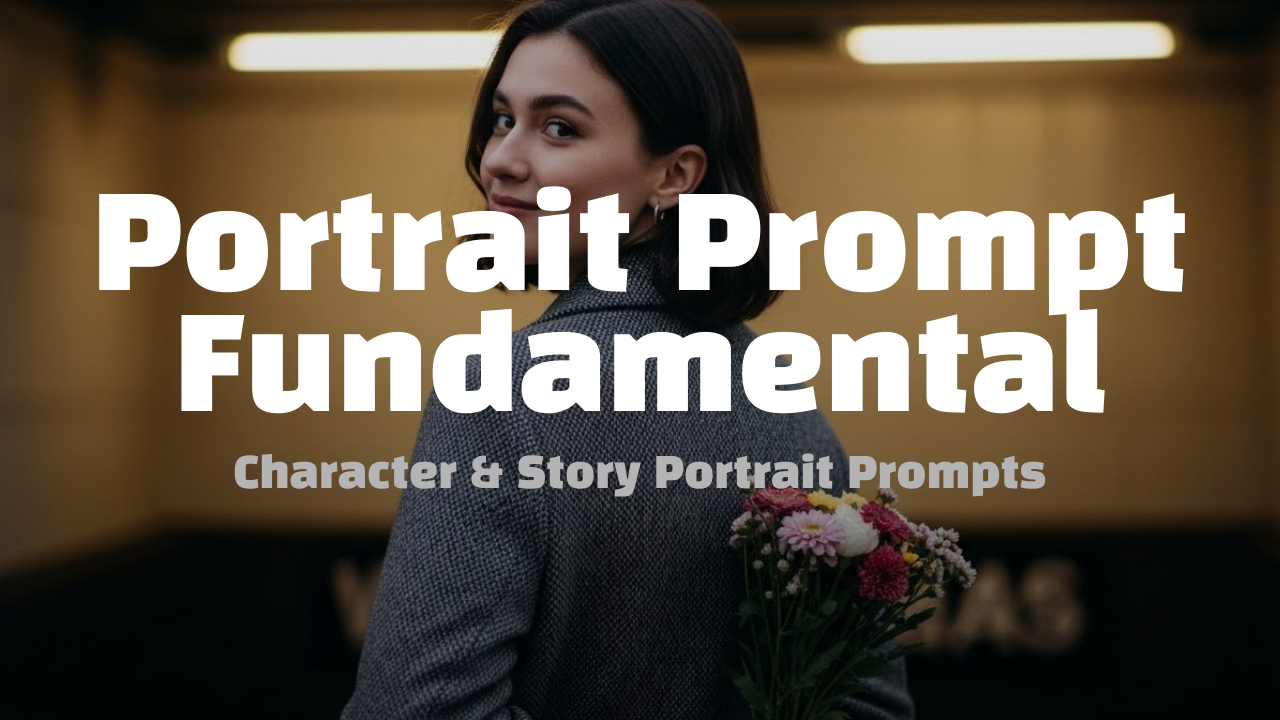
Why “content portraits” need story structure
Once you can generate clean portraits, the next ceiling is sameness: different faces, same vibe. Story-driven portraits solve that by anchoring every image in a character concept, a motivated prop, a clear emotion tone, and (optionally) a film/genre language.
This chapter gives you systems that scale into content:
- Character setups (job/concept + wardrobe + setting)
- Prop-driven storytelling (object → action → implied narrative beat)
- 12 emotion tone packs (expression + lighting + color palette)
- Film still recipes (noir, romance, thriller, more)
- Fashion editorial frameworks (runway/backdrop/high fashion)
- A 10-image series storyboard template for consistent production
The master formula (copy/paste)
[character concept + role],[wardrobe + styling],[prop + interaction action],[emotion tone pack: expression + gaze],[lighting + time of day],[location + scene cues],[camera + shot size + lens],[color palette + grade],[story beat (optional, one line)]Safe defaults (for believable story portraits)
- Character: one clear role + one defining trait (e.g., “night-shift paramedic, calm under pressure”)
- Prop: a prop that belongs in the world (book, umbrella, camera, flowers, ID badge)
- Action: a small action (turning a page, checking time, wiping rain, adjusting strap)
- Emotion: subtle, readable, not theatrical
- Scene logic: lighting must match location (neon in alley, skylight in museum)
- Avoid: random props with no action, contradictory mood cues, “everything cinematic” at once
1. Character Setup (Job / Concept Character)
A strong character setup answers four questions:
- Who are they? (role)
- What defines them? (trait)
- Where are they? (setting)
- What are they doing? (action)
Character template (copy/paste)
[role], [defining trait],wardrobe: [3 items max],setting: [specific place],action: [small believable action],tone: [one adjective]Character idea library (examples)
1) Coffee shop writer
aspiring novelist, quietly observant,wardrobe: oversized coat, knit scarf, minimal jewelry,setting: corner table in a cafe,action: annotating a notebook beside a half-finished latte,tone: warm and reflective2) Night-shift paramedic
night-shift paramedic, calm under pressure,wardrobe: utility jacket, ID badge, worn boots,setting: ambulance bay at night,action: checking a clipboard, subtle fatigue in posture,tone: grounded and determined3) Museum curator
museum curator, precise and composed,wardrobe: tailored blazer, turtleneck, simple watch,setting: quiet gallery hallway,action: adjusting gloves while reviewing exhibit labels,tone: editorial calm4) Street photographer
street photographer, curious and restless,wardrobe: denim jacket, camera strap, crossbody bag,setting: neon-lit street corner,action: raising camera, scanning for the next frame,tone: alert and cinematicTroubleshooting (character)
- If the output feels generic → add one specificity: “ID badge,” “worn boots,” “exhibit labels,” “receipt printer” (one cue max).
- If it feels costume-like → reduce wardrobe items and remove exaggerated adjectives.
- If it feels confused → reduce to one role + one action + one location.
2. Prop-Driven Storytelling (Object → Action → Beat)
Props work when they imply an event. Use the chain: prop → action → story beat
Prop storytelling template (copy/paste)
prop: [object],action: [interaction],implied beat: [what just happened / what will happen next]Prop library (ready-to-use)
Book
- action: “turning a dog-eared page”
- beat: “studying something important”
Flowers
- action: “holding a bouquet behind their back”
- beat: “waiting to meet someone”
Umbrella
- action: “closing a wet umbrella, shaking off rain”
- beat: “just arrived from a storm”
Camera
- action: “adjusting lens focus ring”
- beat: “hunting for a decisive moment”
Letter / envelope
- action: “thumb tracing the seal, hesitating”
- beat: “unsure whether to open it”
Suitcase
- action: “hand on suitcase handle, pausing”
- beat: “about to leave or just returned”
Troubleshooting (props)
- If prop feels random → add an action and an implied beat.
- If prop overwhelms the portrait → keep it “partially visible” and reduce emphasis.
- If hands distort → choose a simpler action (holding strap, resting on handle).
3. Emotion Tone Packs (12): Expression + Lighting + Color
Emotion becomes consistent when you bundle:
- expression cues (eyes, mouth, posture)
- lighting cues (soft vs hard, direction)
- palette cues (warm/cool, saturation)
How to use tone packs
Pick one pack and apply it across a set. Don’t mix multiple packs in one image unless you explicitly want contrast.
The 12 tone packs (copy/paste)
1) Calm
calm expression, relaxed eyelids, soft catchlights,soft directional light, low contrast,neutral palette, natural skin tones2) Warm
warm expression, gentle smile in the eyes,soft window light, gentle highlights,warm neutral palette, subtle warmth3) Joyful
joyful expression, slightly lifted cheeks, bright eyes,open soft light, moderate brightness,warm vibrant palette, clean contrast4) Playful
playful expression, side glance, subtle smirk,mixed soft light with small highlights,bright accents, slightly higher saturation5) Shy
shy expression, downward gaze, relaxed mouth,soft diffused light, low contrast,muted warm palette, gentle shadows6) Reflective
reflective mood, looking off-camera, subtle brow softness,side window light, soft falloff,cool-neutral palette, subdued saturation7) Melancholic
melancholic expression, quiet eyes, minimal smile,low-key soft light, deeper shadows,cool palette, lowered saturation8) Dreamy
dreamy gaze, slightly unfocused look, gentle posture,soft backlight with mild diffusion, glow controlled,pastel palette, soft contrast9) Determined
determined expression, direct gaze, subtle brow tension,directional key light, moderate contrast,neutral palette, crisp micro-contrast10) Intense
intense gaze, still posture, minimal expression shift,harder directional light, high contrast,dark palette, selective highlights11) Curious
curious expression, slight head tilt, alert eyes,soft directional light, clean highlights,balanced palette, natural saturation12) Mysterious
mysterious mood, partial shadow, indirect gaze,split or low-key side light, controlled fill,cool palette with selective warm accentsTroubleshooting (emotion)
- If emotion looks over-acted → replace strong words with “subtle,” “gentle,” “quiet.”
- If emotion looks unclear → specify gaze direction + brow tension.
- If palette overwhelms skin tones → request “natural skin tones” and reduce saturation.
4. Film Still / Genre Recipes (Noir · Romance · Thriller)
Film stills work when you describe “motivated light,” composition, and a story beat.
A) Noir (high contrast, shadow shape)
film still portrait, noir mood,split lighting or hard side light, deep shadows, minimal fill,wet street reflections, smoke haze controlled,cool tone with selective warm highlights,story beat: waiting for someone who may not arriveB) Romance (soft, warm, proximity)
film still portrait, romantic mood,soft backlight or warm window light, gentle highlights, low contrast,close proximity framing, warm palette,story beat: a quiet moment before a confessionC) Thriller (tension, pockets of light)
film still portrait, thriller mood,high contrast, pockets of light, motivated neon or streetlamp,sharp shadows, controlled haze,cool palette, tense stillness,story beat: hearing footsteps behind themTroubleshooting (film still)
- If it looks like “random cinematic” → add one story beat and one motivated light source.
- If it’s too dark → add “subtle fill on face” while keeping contrast.
- If it’s too glossy → remove “perfect” language and add texture cues.
5. Fashion Editorial Frameworks (Runway / Backdrop / High Fashion)
Editorial portraits work when you specify:
- styling intention (silhouette, materials)
- backdrop logic (studio sweep, textured wall, branded runway)
- lighting style (hard vs soft) tied to editorial tone
A) Runway-inspired (movement + distance)
fashion editorial portrait, runway-inspired,full-body framing, confident stride, garment movement,clean stage lighting, controlled contrast,minimal background, sharp styling emphasisB) Studio backdrop (graphic simplicity)
fashion editorial portrait, studio backdrop,solid seamless background, hard directional light, crisp shadows,styling-forward composition, clean negative spaceC) High fashion close-up (beauty + edge)
high fashion close-up, editorial makeup,hard side light, sculpted shadows, high contrast,intentional pose, minimalist background, refined color gradeTroubleshooting (editorial)
- If it looks like “catalog” → add harder light or stronger composition constraints.
- If it looks too harsh → soften diffusion slightly but keep directionality.
- If it loses realism → add skin/hair micro-texture cues.
6. Portrait Series Planning (Same Model, 10 Images)
A series needs controlled variation: keep 3 constants, change 2 variables per frame.
Series rules (simple and scalable)
Keep constant (choose 3):
- same character concept
- consistent palette and grade
- consistent wardrobe silhouette
- same location family (e.g., “subway + street”)
- same lens family (35mm/50mm/85mm)
Change per frame (choose 2):
- shot size (close-up → half-body → full-body)
- action (prop interaction)
- gaze direction
- lighting intensity (soft → directional → high contrast)
- time beat (arrive → wait → decide → leave)
10-image storyboard template (copy/paste)
- Establishing: location + character reveal (full-body)
- Detail: prop introduced (half-body)
- Emotion: subtle mood set (close-up)
- Movement: walking or turning (full-body)
- Interaction: prop action (half-body)
- Tension: shadow/contrast shift (close-up)
- Choice: decisive posture (half-body)
- Consequence: distance or separation (full-body)
- Aftermath: quiet reflection (close-up)
- Closing: final beat + visual motif repeat (half-body or full-body)
Series prompt wrapper (apply per frame)
same character concept, consistent wardrobe and palette,frame [#]: [story beat],[shot size], [pose + action], [prop interaction],[emotion tone pack],[lighting + time of day],[location cues],[color grade consistent across series]Starter prompts (complete, ready-to-run)
1) Prop-driven romance film still (flowers)
film still portrait, romantic mood,character: young architect, quietly hopeful,wardrobe: tailored coat, minimal jewelry,prop: small bouquet of flowers, action: holding bouquet behind their back,emotion pack: warm expression, gentle smile in the eyes,soft backlight, gentle highlights, low contrast,location: subway exit at dusk, soft ambient city glow,warm neutral palette, natural skin tones,story beat: waiting for someone who might finally show up2) Noir character portrait (letter + split lighting)
film still portrait, noir mood,character: private investigator, tired but focused,wardrobe: trench coat, loosened tie,prop: sealed envelope, action: tracing the seal before opening,emotion pack: mysterious mood, indirect gaze,split lighting, deep shadows, minimal fill,location: night alley, wet pavement reflections, controlled haze,cool palette with selective warm highlights,story beat: realizing the case is personal3) 10-frame series kickoff (street photographer)
portrait series, consistent character concept across 10 images,character: street photographer, curious and restless,wardrobe: denim jacket, camera strap, crossbody bag,palette: cool-neutral with selective neon accents,frame 1: establishing,full-body portrait, walking mid-step, prop: camera in hand, action: scanning for a shot,emotion pack: curious,motivated neon spill light, cinematic street scene, controlled haze,location cues: neon signage, wet sidewalk reflections,color grade consistent across seriesMini checklist (publish-quality story portraits)
- Character is one clear role + one defining trait.
- Prop is motivated and includes an action (prop → action → beat).
- Emotion is specified as a pack (expression + lighting + palette).
- Film still genre includes motivated light + a one-line story beat.
- Editorial portraits specify backdrop logic and light direction.
- Series planning keeps constants and changes only a few variables per frame.
- Avoid “everything at once”: one character, one prop action, one emotion tone.